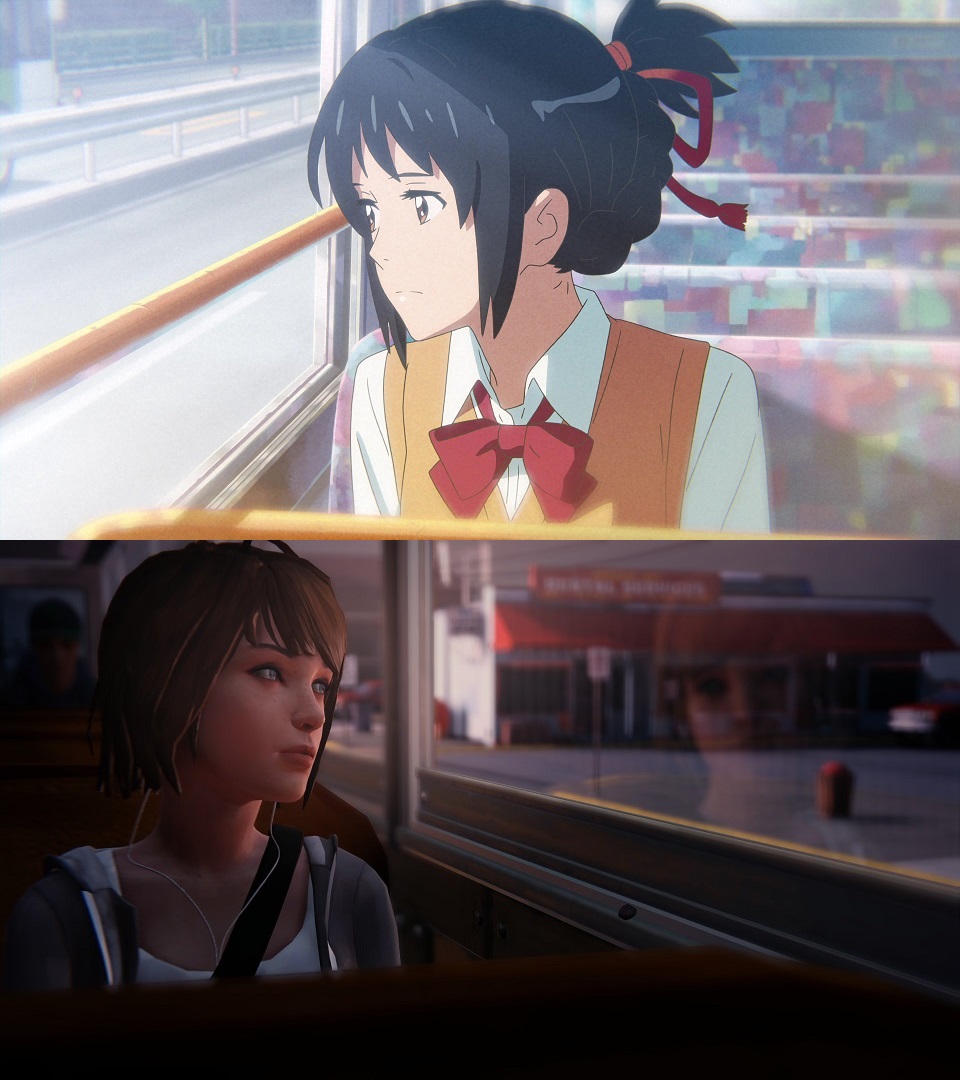
If you've been reading my previous blog entries, you probably knew this post was bound to happen.
As someone who enjoyed Your Name., I was eager to see Makoto Shinkai's next film: Weathering with You. Prior to the film's release, my expectations were tempered by "harsh realities" such as how Game of Thrones: Season 8 ultimately turned out, or the "ties" that Life is Strange 2 shares with Life is Strange (or lack thereof). Thus, I approached Weathering with You as it's own film, and not the sequel to Your Name. I was fortunate to see the film (with English subs) on September 1, 2019 in an IMAX theater (no less), but I intentionally held off from publishing this post until after having watched the English dub of the film. The dubbed version finally was released to certain online platforms on August 5, 2020 - almost a year since I first saw the film.
When asked by Gamespot at the 2019 San Diego Comic-Con what makes a Life is Strange game, the game's co-director Raoul Barbet responded by saying:
...it'll be the artistic direction, it will be that we want to create, first, believable characters and a good story, and that tackles some actual subjects of society's problems and that kind of stuff, and puts the player in some interesting situations. And in the end, you've got the supernatural element...Hmm. Believable characters? Society's problems? Interesting situations? Supernatural elements? A good story? It appears that Weathering with You satisfies all those requirements, perhaps more so than Your Name. Heck, the film's basic setup reads like a story pitch for a new entry in the Life is Strange series. A teenage girl in Tokyo named Hina Amano has acquired the power to stop the rain, becoming the so called Sunshine Girl. She eventually gets to meet up with this runaway kid named Hodaka Morishima, who goes into business with her by making use of this newfound power. Little do they know, that their actions would have unforeseen consequences.
 |
| Yeah. It's Life is Strange in all but name at this point. Source. |
Now before continuing on to the rest of the post, I'll be talking a bit on the film's visuals. Compared to Your Name., Weathering with You has more detail in some scenes, but the cinematography isn't as vibrant. With the film being a showcase of rainy days in Tokyo, this was to be a given. Drab grey skies aren't exactly full of color. Then there was an awkward 3D scene of a fireworks display that somehow looked worse than the one from A Silent Voice. The water in the film looks excellent, albeit a bit too good in the sense that it looked too clean. Which would be fine, if not for the fact that some of that ought to be depicting flood water, and not clean fresh water.
Hmm... the overall point of this comment sounds oddly familiar: "In the long history of humankind... those who learned to collaborate and improvise most effectively have prevailed." Now despite the theme of "hope in the face of adversity", the decisions shown in the film that lead up to the ending will cause some concern. As Kotaku commented:
So, with all those eight conditions addressed, does this mean that Weathering with You provides Life is Strange fans a glimpse of the Bae ending the game deserved? Well, not quite. A viewer shared these thoughts:
With Hodaka having an air of mystery that didn't help with his characterization, surely Hina fared better? On the surface, this might seem the case. Hina is depicted as upbeat and selfless. Despite being 15 years old, she is surprisingly self sufficient despite being introduced as a McDonalds employee and is presumably still in school. And somehow she can provide for her younger brother as well. That is very commendable, although beyond that, there isn't much to her. As mentioned in Polygon's review of the film:


Grand Escape:
While the song was intended to be an entrancing, ear catching interpretation of Hodaka and Hina's break out from the clouds (or from the society that wants to keep them apart), the lyrics are inclusive enough that I'd say it fits well with the aftermath of the Sacrifice Arcadia Bay ending. Since the song doesn't have an official English version, For this post, I'll be using lyrics from cover artist Mewsic.
In the final episode of Life is Strange 2, players are treated with a cameo of David Madsen, Chloe's stepfather. In one of game's the most pivotal conversations, David tells us how he felt upon finding out that Max and Chloe seemingly just leave after the destruction of Arcadia Bay: "I used to hate them for running away. They hit the road straight away, never to look back, while I was trying to rebuild." Now while this statement was slightly clarified when David later said "Took me a while to acknowledge the past was the past and move on, like they did", reflecting upon his words as a history fan leaves some room for negative interpretation. At best, those lines from David are a poor way of saying "Don't cry over spilled milk" or "build on what’s come before while learning to evolve too." At worst, they tell us that Max and Chloe took to heart Kylo Ren's most infamous line from Star Wars: The Last Jedi: "Let the past die. Kill it, if you have to." Besides killing the past, what better way to let it die than to run away from it whilst stubbornly refusing to look back regardless of any upsides? I honestly hope it ain't the latter as that will really piss me off, because it will only reinforce this disturbing notion that Max and Chloe were little more than self centered a**holes. Why else would David initially hate them when he is told of the pair's whereabouts? It simply doesn't fit with the characterization that the game has built up for Max especially. The one silver lining I see in this situation is the fact that Dontnod didn't confirm outright that Pricefield is a reality post game either. So if those die-hard shippers believe that their only true pairing is a reality post-game, I'll go out on a limb and make it my headcannon that Max and Chloe didn't just simply ran off like cowards. At the very least, it was Max that called for emergency responders to help save the survivors.
[End Rant]
Thankfully, Radwimps are far more adept at wordsmithing than Dontnod (despite not being native English speakers as well). Through the song, they frame two individuals who simply want to start anew in a different place. The lyrics they've composed are so much better than a blunt and selfish "they literally ran away and never looked back."
Because of this, the song sugarcoats the choice made by the protagonist to save a love one and while others have to suffer in her place.
Before moving on, I want to give a friendly reminder to any Life is Strange fan what one of the game's co-directors has said on record regarding the game's ending:
If there was to be a film set in the Life is Strange universe (an adaptation of a well made Max and Chloe fanfic, perhaps?), Makoto Shinkai has made a strong case that he's probably the most prominent director in the industry to do such a film justice. While his previous works illustrate his effectiveness of delivering an "emotional roller coaster ride," Weathering with You demonstrated his willingness to explore topics affecting society at large.
An Inconvenient Truth
In my impressions post for Your Name, I wrote that the film lacked social commentary. While its absence is not a complaint I have with Your Name (since it had different priorities), it became the cornerstone for Weathering with You. An interview from a Japanese women's magazine reveals the film's genesis:
The inspiration for Weathering With You came in the summer of 2016, when, exhausted from all the promotion he was doing for your name., Shinkai looked up at the sky and saw a cumulonimbus cloud. When the skies cleared, he felt healed, which gave him the idea that the weather and the human spirit are connected.
When the time came to start working on his next film in earnest, Shinkai's thoughts turned to climate change. "People say that humans are destroying nature for the sake of their own conveniences, and I agree with that," he said. "And yet I'm the kind of person who doesn't hesitate to turn on the air conditioning in my room when it's hot. Climate change is a large-scale phenomenon with an unimaginable scope, but there's not much a person can do about it on an individual level. Even so, my actions as a single person have a definite effect on the environment. It may feel like something that's out of your realm of responsibility, but it absolutely isn't. I made the film while thinking about how to deal with that problem through the framework of entertainment."With that, Shinkai crafted a story that had to convey this message. Weathering with You shares one of the key themes of one of my favorite all time films, Jurassic Park: man vs. nature. The struggle of man to tame the elements to his whims, and the natural world pushing back against our efforts to upset the established order of things was a compelling idea the film aimed to deliver. Some reviewers managed to hit the nail right off the bat. Take for example what Cinema Escapist had to say:
A central plot element in Weathering With You is the rainstorm in Tokyo—and how weather affects, and can be affected by humans....
Various Tokyo residents seek Hina’s help to pray for sunshine at key events in their lives—be it farmers markets or weddings—because sunshine improves people’s moods. While this mood effect is rooted in scientific fact, the aversion that Tokyo residents have towards rain may well be a reference to the pain and suffering that come from climate change’s aggressive weather impacts.
Hina’s ability to affect the weather also parallels to how humanity has an opportunity to avert the worst-case outcomes of climate change. Throughout the film, Shinkai makes it obvious that Hina has the ability to prevent an ecological disaster for Tokyo by casting away the rain storm.
Unfortunately, Hina struggles with her powers much in the same way that contemporary society struggles with addressing climate change. While Hina has the ability to solve the environmental [catastrophe] facing Tokyo, she has to sacrifice significant parts of her relationship with Hokada in order to save the city—a sacrifice that Hokada is unwilling to allow Hina to undertake.... [T]he tension between doing what’s best for society, versus doing what’s best for the couple more [selfishly], is a major point of tension throughout the plot of the film. Most movie-goers will see this tension as part of a broader romantic drama, but we see it as part of an allegory for how society must choose between short-term selfishness and long-term selflessness in order to address climate change.The Jakarta Post shared similar sentiments:
We learn that the rain never stops to the point when people could not even have wedding ceremonies, marathon competitions, or even firework festivals. Through this, we learn that people rely so much on the weather. We learn that through these sequences, humans are selfish individuals who think only of their needs and not of others. This is what Shinkai tried to portray.
Weathering with You might look like an adventure/coming of age/comedy film about two teenagers trying to survive in Tokyo by controlling the weather. But upon dissecting the movie carefully, a more profound argument lies within. It’s about how the world has changed and how we choose not to care. Shinkai still cleverly crafted Japanese spiritual values as a detrimental element in the film. While in Your Name he played with how the Japanese perceived time, in Weathering with You Shinkai portrays the mystery of sky, Earth and a maiden who connects them both to create a balance. A legend stated that the maiden who connects both the Earth and the sky should sacrifice herself. In other words, Hina’s ability to control the weather had ramifications we know nothing about until the last part of the film's second act.
That statement triggered a lot of questions. First, why Hina? The beginning of the film said it all. Hina was the only person who realized that there was a sunny day on a magical shrine. She was the only one who was willing to get out of a building, leaving her mother in the ICU to walk in the rain looking for the source of the light on an abandoned building and actually praying in the shrine. With that, Shinkai managed to portray our careless society. Our society often takes the weather for granted so we do not recognize a weather anomaly. In the film, praying at the sacred shrine earns you control over the weather and restores the balance. That person happened to be Hina.
But Hina had a bigger purpose than just clearing the sky at someone's request. As I said, there were ramifications. Her ultimate job was to restore balance. The weather would be back to normal if she sacrificed herself. That narrative lingered in my heart. Are we so careless toward Mother Nature that the only way we relate to her was by sacrificing a human being to restore the balance of nature?
And so the third act of the film explores that question. Would it be okay to sacrifice an innocent teenage girl who was just trying to survive in Tokyo for a clear sky? Or would it be OK to accept the fact that the rain would never stop pouring even though it’s summer?
Compared to Your Name, Weathering with You has a stronger sense of urgency. It may not be as romantic as Your Name, but Shinkai brought something else to the table: an extremely important topic to be discussed. It was presented so subtly that we may not realize what this film tried to argue in the first place.Reviews such as these helped a lot in appreciating what the film tried to convey after my first viewing. The film raises the question: what is the cost we are willing to pay to save the world? Do we have to sacrifice human lives in the process? In one interview with Shinkai, The Japan Times provides some insight on the film's moral dilemma:
Perhaps the question Shinkai is most interested in exploring in Weathering With You is [if] the needs of society should always be put ahead of the needs of the individual.
It’s a question he’s allowed to explore, he says, precisely because it’s packaged in the form of entertainment.
“To say the person right in front of me is more important than society … (is something) politicians and those in power definitely aren’t allowed to say, right?” he says. “You can’t write it in newspapers or textbooks either.”
However, he says, “in entertainment, you’re free to yell it at the top of your lungs.”
“And when you do, it makes viewers think about things,” he says. “Some people will agree, others will strongly oppose it. At the very least, it should help people understand what kind of society we are living in.”
In some ways, it almost sounds as if Shinkai considers Weathering With You to be a massive social experiment.
“How will Japan react to the film?” he asks. “Will it be accepted, rejected or ignored? The reaction will help me see the form of our society, to figure out how people are really thinking right now.”But it wasn't just about climate change that was a key theme of the film.
Hope is a weapon. Survival is victory.
In a piece that talked about why Your Name is better than Weathering with You, the article's first comment caught my attention. Besides being surprisingly long, it had an insightful take on the film's ending:
The film really looks at change and the human ability to persevere and ultimately adapt to what is new (and often frightening) by drawing on even the smallest pieces of hope. We are introduced to this first as Hodaka leaves his more rural ‘forest island’ home (literally implied in his name) and travels to Tokyo. Everything there is scary and overwhelming. The “Tokyo is scary” lines that are repeated are used to mirror in viewers how often and easy it is for us as human beings to feel afraid and overwhelmed when faced with the unknown/ uncertain/ hostile. For Hodaka, that takes the form of moving to a city he’s not been to before that is vastly different from rural/ islands in Japan. However, to the viewers, it gets one contemplating how we individually process the enormity of thinking about the unknown, uncertain, and potentially hostile future and growing up and moving into a space where we know that immense challenges (environmentally, economically, socially, etc.) lay ahead of us.
At the end of the film, as we see Tokyo engulfed in water – a genuinely unsettling sight however, the anxiety that surrounds the realities facing all the characters are contrasted with the easy in which boats have replaced the highly complex train system – things still run, humans still persevere and hope is never abandoned. There are also the subtle comments of passers by… on the bridge one girl says to another “you’re so optimistic” and one also comments saying: “I’m really looking forward to the picnic” – despite the rain, we see that humans still find small pockets of joy and reasons to keep moving forward. Even [Kei] says “don’t worry, it’s gonna work out” after Hodaka visits him in his new office. There are myriad reasons for Hodaka and Hina to lose hope in the world (just as there are many reasons we see lots of individuals, young and old feeling overwhelmed, afraid and hopeless when thinking of the future), there are reasons for them to blame themselves for their contributions to the state of the world (as is the case with us as viewers, who arguably in some capacity contribute to what many view as a rapidly bleak/ unsettling global future be it through social/economic/environmental/political, etc. contributions or lack of actions. Hodaka and Hina could even to blame the world and people around them for indulging in selfish acts (requests from the sunshine girl) and for the people who took for granted the convenience of fulfilling their needs and failed to consider if there was a true cost to their selfish desires to manipulate the weather… which ultimately lead to the unending rain and the bleak reality they and the rest of the world now face. Likewise it’s easy for us (viewers) to look at the state of the world and blame person x, or country y, government z, etc. for how we’ve basically reached a tipping point in being unable to maintain the world as it was (at least environmentally/ economically/ technologically etc.)… our desire for convenience made us blind to the costs and now we are faced with a scary, bleak future.
But the ending show us that Hodaka takes ownership of how they have all come to exist in the world they now live in and states that they “made a choice”. Their choice is what they live with now, and because of these small pockets of hope and the human ability to find love and support and moments of joy/ wonder/ contentment/ etc. in any situation they will be alright. The world and humans will be alright as long as we find these moments, that keep us moving forward. Moments that we largely find and draw support from through our connections to others.
Hodaka lacks a back story because the themes the movie explores are bigger than him. Hodaka isn’t simply supposed to be [a] romance movie lead. Neither is Hina (we learn some things about her, but she is still a significantly vague individual who reflects our desire to connect with others and find purpose/ personal fulfillment, despite the costs to ourselves and others.
Hodaka and Hina are us. Hodaka’s fear and uncertainty shows the journey of how humans come to persevere. Hina’s sacrifice shows the ease at which humans can be overwhelmed and consumed by the immensity of the pressures a scary/bleak future weigh on us. All characters in the movie in some capacity show that we as humans are selfish but that that’s okay. That we will be alright, so long as we have small bits of hope to cling to. Hope that blossoms in the presence of others.
The movie is a message of hope to the viewer. A commentary on where we’ve been, where we are, where we’re headed and how we will, as a species continue to move forward no matter the odds… because we are humans, who can hope and who have the power to “change the shape of the world” both physically and metaphorically.
If you saw this as just a straight up romance film, Shinkai completely hoodwinked you. It’s not the same formula, but as a human you search for that familiarity – because humans are subconsciously drawn to find and cling to what is “safe” and “normal” and “familiar”. You missed a huge theme when it comes to humans: their ability to change and adapt unless forced. Your mind didn’t look deeper into the film and you felt like [Weathering With You] didn’t “live up” to [Your Name] because of this. You missed the masterpiece before you because you were fixated on a “standard” on your expectations of the norm.
This film is about tackling the idea of change… of what makes us uncomfortable, put-off, scared, uncertain and how people cope with change… especially when looking towards the future (one riddled with these feelings). The use of very rapid, visual changes though depicting weather and environment is something Shinkai again uses to comment on how easy it is for people to take things as normal… for granted. Just as you have with assuming this film was a simple romance movie. Clinging too closely to something you know, take pleasure in, and are comfortable and familiar with (aka Kimi no na wa’s mass appeal plot). In doing so, you miss something greater.
You miss understanding the psychology of the self and the world around you. You fail to look introspectively at what this film says about humans. Shinkai is targeting those who when faced with change that makes them uncomfortable or that seems “off” are immediately adverse to it and would crumble under the realities of very really and rapid future changes in our own world. He’s urging you to embrace something different, even if it isn’t what you expect or desire, because that will rapidly be a real world reality for many (as I mentioned… environmentally, socially, economically, etc.)
But that’s again, why the so-called “happy” ending is there… to give us hope. To tell you it’s okay that even if you failed to realize the bigger, deeper, more complex and introspective/critical picture (in this film, and in life), that as long as there are others there who are willing to share in this human experience with you, to support those who fail to comprehend change or who struggle to accept it and cling to the past… As long as you have the “love” of others to support you, there is hope and you (and humans) will grow, persevere and become better for it… Even when faced with unsettling change.
While the characters are sympathetic, some of the decisions made later in the movie are downright selfish, with little thought given to the larger ramifications of their actions. They’re teenagers, so I guess that makes sense, but once they’re confronted with the results of those decisions, there doesn’t seem to be much reflection or thought given to them.One viewer wrote down:
The message that the romance at the end of the film sends is very dangerous. Again, any details would be spoilers, so I'll use this quote from another show I watched that I fully agree with after watching the ending:
"The kind of thinking that as long you and your own are happy then you don't care about other people is...horrifying...it was like the movie was jam-packed with people's egoism."
The characters are a model of the good old "as long as we are in love the world can go to hell" trope towards the end to an extreme level. And if people feel "inspired" by the message in the end, I think we are doomed as a society.And since we are talking about that ending...
Sacrificing Arcadia Bay... take two
If you asked me before I got to actually watch Weathering with You and give one notable similarity with Life is Strange, I would've instantly reminded you of the fact that Hina can stop the rain. What I didn't bet on at the time was that the film shares a far larger parallel than a female teenage protagonist with a supernatural power. It was so unexpected, that my jaw dropped when I saw this parallel unfold for the first time on an IMAX screen. Of course, I'm talking about Hodaka's decision to Sacrifice Tokyo in order to Save Hina. Just when I hoped I finally put to rest all the emotions I felt with the game's ending, Weathering with You had to remind me once again of the Bae vs. Bay debate....
Surprisingly, not everyone who finished the game hated the execution of the endings. One fan on Reddit wrote this:
At first glance, one might assume that Weathering with You simply borrowed the Sacrifice Arcadia Bay ending. But upon closer inspection, there are notable differences... most of them I feel are major improvements. In my post on Your Name, I commented that the "Saving Itomori" sequence gave me the impression it could have been written by someone who disliked the mutually exclusive choices Life is Strange forced upon the player and the lack of a third option to save a heroine along with the town. In the spirit of that mindset, Weathering with You's ending could have been from a Life is Strange fan who wanted better closure to the Sacrifice Arcadia Bay ending.
The sacrifice Arcadia Bay ending may seem like it was rushed, lazy even, but it was done so brilliantly.
In that ending, the book hasn't been closed, it starts anew. A blank slate for us, the players, to continue the story.
We don't hear anything except music because it's us who has to fill in the blanks. We get to write the next chapters of their story; what they're feeling, what they're thinking, where they're going, if anyone survived, etc.
I like that Dontnod didn't make anything official in [Sacrifice Bay] ending. It's up to us now to continue the story....If this fan thought the Bae ending "was done so brilliantly", then by that standard I'd say Weathering with You's ending is beyond brilliant to the Nth Degree.
At first glance, one might assume that Weathering with You simply borrowed the Sacrifice Arcadia Bay ending. But upon closer inspection, there are notable differences... most of them I feel are major improvements. In my post on Your Name, I commented that the "Saving Itomori" sequence gave me the impression it could have been written by someone who disliked the mutually exclusive choices Life is Strange forced upon the player and the lack of a third option to save a heroine along with the town. In the spirit of that mindset, Weathering with You's ending could have been from a Life is Strange fan who wanted better closure to the Sacrifice Arcadia Bay ending.
Based on how "Sacrificing Tokyo" was portrayed in the film, if Shinkai was in charge of crafting the Bae ending, it had to meet all of the following conditions:
- The protagonist needed to be someone who felt that society stacked against his/her favor, causing him to feel apathetic to society in general, and had a clear rationale why he/she would pick his/her significant other over society. Plus, the protagonist had to be morally flexible, and not necessarily a nice, compassionate individual to most people.
- There was no other way to save "the sacrificial female character" other than allowing a natural disaster to devastate an inhabited area.
- The place affected by the Storm was an artificial construct that upset the natural balance. In the film's case, it was the fact that parts of Tokyo were reclaimed land from the sea.
- The Storm didn't doom virtually everyone in its path to certain death.
- We get a definitive answer as to who survived among the main cast.
- There needs to be a bit of closure with at least some of the secondary characters.
- The place affected by the Storm is not left uninhabited, and that some of its inhabitants have rebuilt their livelihoods & adapted to their new reality.
- The audience gets to see the protagonist facing some external consequence for their action, one that is not caused by what they feel about the situation. For Weathering with You, this was depicted by Hodaka's eventual arrest by the police, and his exile from Tokyo for the next three years.
In the context of all five episodes of Life is Strange, none of the aforementioned points are directly addressed. This fact only highlights the game's lack of closure, driving fans to speculate on questions such as who lived or died. Among these points, "number three" provides a little known parallel between Life is Strange and Weathering with You. As some Life is Strange fans are aware, the setting of Arcadia Bay was based on the real world location of Tillamook Bay in Oregon.
 |
| Sorry, but only a few buildings stand where a sprawling town ought to be. |
 |
| Whoever gets to make a live action film set in the Life is Strange universe will hopefully find the means to construct a bigger lighthouse here. |
What is lesser known among Life is Strange fans however, is the fact that Tillamook Bay is the site of a settlement that was reclaimed by nature: a town called Bayocean, aka "the town that fell into the sea."
The Guardian has an interesting article on the lost town. Here are a few pertinent excerpts:
The Guardian has an interesting article on the lost town. Here are a few pertinent excerpts:
...there’s one lost Oregon town that gives us a tightly focused image of the future. There are no remains of Bayocean for the visitor to see – they’ve long since been claimed by the waters of Tillamook Bay. Though the wild weather of the Oregon coast administered the coup de grace to the town in the 1950s, in truth, the residents themselves destroyed it by misunderstanding and carelessly tampering with the natural systems that allowed it to exist....
The only means of transport for visitors to get to Bayocean was [a] yacht, also called Bayocean, which sailed back and forth from Portland once a week. This trip was occasionally terrifying: passengers had to cross the infamously treacherous Columbia river bar and the mouth of Tillamook Bay, which was also frightening in rough weather.
The residents demanded a protective jetty to smooth this journey. The US army corps of engineers took one look at the bay and said they’d need two. The residents... would have to shell out over a million dollars, so they settled for one.
This is the way they ended up paying for the destruction of their own property, and the city. The jetty changed the current, which began steadily wearing away the sand on which the whole town rested.... As early as 1928... the seaward side of the spit had been significantly eroded. It didn’t stop.
Every bit of rough weather now posed an existential threat to Bayocean. In 1932, a massive storm destroyed [the town's public swimming pool]. By 1938, 59 homes had disappeared, and residents had long since begun fleeing in earnest....
In 1952, the spit became an island, when heavy seas smashed through the barrier, altering the ecological balance of the bay and the estuary that fed into it. In 1953, the post office closed and all residents were evacuated. In 1960, the last house fell into the ocean.In the context of the game sadly, there is no definitive proof that Arcadia Bay was intended to be a fictional Bayocean, an artificial construct that upset the balance of nature. That could have really been the case if the Pan Estates and Native American mysticism subplots in the game were fully fleshed out. I guess Dontnod didn't want their messed up final decision to be made any easier by insinuating the idea that Arcadia Bay was on borrowed time, doomed to be destroyed regardless.
I feel that it's worth mentioning one key difference between Tokyo's submergence and the destruction of Itomori in Your Name. Namely, the body count. In Your Name., it's made clear to the audience that over 500 people were killed when the comet struck the town. There's even a book containing the names of those who died in the tragedy, which included virtually all the characters that lived in the town. Weathering with You however treats the aftermath of the disaster very differently. While it's made clear that most of Tokyo has gone underwater, there is no depiction or mention of anyone getting killed as a result of Hodaka's decision. No radio broadcast, no news or web article, no news reel, no dead bodies. Nothing. As if to reaffirm this point, Taki's grandmother and Mr. Kei both reassure Hodaka that Tokyo's fate wasn't his fault, that it was simply nature reclaiming what was once ocean.
Now on top of all the aforementioned eight points, there's one more additional point that made the ending for Weathering with You a different experience. What is it? The personality of the main female lead who needed to be saved. Since Life is Strange's release in 2015, there has been tons of discussions regarding whether or not Chloe was worth saving. For (at least) some players, she was way too unbearable and simply not a good friend, let alone a worthy love interest. As one comment said, Chloe "acts recklessly, gets people hurt, is selfish and judgmental, and a danger to others and herself". For anyone needing a summary on the "Chloe is the worst best friend" perspective, here's a video on the matter:
In contrast to Life is Strange, Weathering with You makes it clear that Hina's personality was far more accepting to general audiences. While Hina wasn't perfect, she was not "impulsive, egocentric, melodramatic, [and an] extrovert with [a] borderline personality disorder." While one can make the case that Hodaka was "simping" for Hina, at the very least their dynamic didn't feel like "a quintessential toxic and borderline abusive relationship. Complete with gaslighting and guilt trips!" Whether by design or (most likely) by accident, it would seem that Shinkai addressed the "Chloe problem" of Life is Strange by simply changing the role and personality of the girl who gets sacrificed, as well made adjustments for the hero who saves the girl. (Now come to think about it, from a certain point of view, it would seem that if Weathering with You was created by someone who played Life is Strange, it was a story told from the point of view of Chloe. Except Chloe is a guy this time around and that Max is the one who gets sacrificed.)
So, with all those eight conditions addressed, does this mean that Weathering with You provides Life is Strange fans a glimpse of the Bae ending the game deserved? Well, not quite. A viewer shared these thoughts:
...the film's depiction of disaster strikes me as frankly irresponsible. Like, the entire city of Tokyo is flooded. We never see a single person die or even get injured. That just isn't how large-scale disasters work. It feels like Shinkai is trying to excuse Hodaka's decision at the end and make us hate him less by not showing us what the ACTUAL consequences of letting the city sink would be, i.e. probably hundreds (thousands?) dead and thousands (millions?) more displaced, not to mention the property damage, etc.
It's one thing to choose to be selfish when taking the selfless action isn't certain to succeed, or the selfless action isn't necessarily clear, it's another to literally just say "fuck you" to all of Tokyo because you've got yours. That's not impressive or interesting to me, it just makes me want to browbeat Hodaka into doing the right thing. He comes off as nothing more or less than a dumb kid making dumb kid decisions, but the music swells and we're supposed to be happy that a child has ruined the lives of countless people so he could be with a person he knew for like a couple months. And this isn't even really me reading into it, the literal text of the end of the film is Hodaka saying "Nah, this isn't just how it was gonna turn out, I chose this on purpose and could have chosen differently. Sweet!" Two thumbs down from me.Besides feeling that society was devastated by a lovestruck, selfish brat, some felt the film's ending was abrupt. As one viewer wrote:
At the end of the film, I walked out with a lot of questions, and the only answer that I could come up with is that Shinkai never really cared about resolving the side plots, as long as the main plot could have an ending then there would be no reason to complain. But that is not, or should not be the case, and as a result this heavily compromised the characters too...Another viewer wrote:
The ending just... happened. There was no mystery to solve, plot twist to surprise or trope to subvert. Some plot threads such as the bad guys of the movie, the backstories of the two main characters and the whole weathering powers in general were not expanded upon very much. I feel like if those plot threads were explored more then Weathering With You would have had a less indecisive moral of the story and there would be a point to anything happening. But nope. The main character gets the girl he wants and that's it: end of the movie!At least one viewer really felt aggravated enough that he/she had to express the following:
The destruction of HALF of Tokyo, Japan’s most economically viable area, was economic genocide perpetrated by a horny 16 year old. Sure, saving your “Girlfriend” is cool, but did you take into account the SEVERE economic recession caused by crumbling Aggregate Demand (AD) in the financial and political nexus of Japan? I don’t think so!!!! The billions of damaged infrastructure caused by [Hodaka's] headass refusal to consider the crippling debt the Japanese government owes (>200%) and beleaguered Aggregate Supply caused by an aging workforce caused the Japanese economy to go into a DEEP recession. When investment is crippled when [marginal efficiency of investment] is lackluster and consumption crumpled because of decreasing nominal income rates and the lack of availability of credit, YOU HAVE A FUCKING HIGH ASS RECESSION. [Hodaka's] action has only 1 upside: MAKING SPACE FOR AT LEAST 6 SEAWORLDS. Guys! They abuse animals! Not fucking cool. This should come across as a lesson for all horny teenagers trying to run away from home: IF YOU MEET A GIRL WHO GETS FUCKED BY THE CLIMATE, THINK OF THE POTENTIAL ECONOMIC CONSEQUENCES. Nice going, dipshit!
By now, I'm genuinely curious to know if Shinkai has played Life is Strange, or is at least aware of the game's problems. Because if he hasn't prior to Weathering with You's release, I'll really be surprised as he seems to display an acute understanding as to why the game's endings were so unsatisfying.
Flying Spaghetti Monsters
When I was a kid, one of my favorite books was Karl Shuker's The Unexplained: An Illustrated Guide To The World's Natural and Paranormal Mysteries. One entry in the book was about this theory of creatures that live exclusively in the Earth's atmosphere, termed by some as Atmospheric Beasts, aka "fauna of the atmosphere". And I was surprised that Weathering with You weaved these cryptids into its plot. But what are these things exactly? Here's an excerpt from one Mysterious Universe article:
[In his book The Cosmic Pulse of Life, UFO author Trevor James Constable concluded] that some UFOs are not nuts-and-bolts craft from distant worlds, but living creatures that inhabit the higher levels of the Earth’s atmosphere. While many UFO investigators scoffed at Constable’s undeniably unique ideas, none could deny that his theory was well thought out. Constable believed the creatures to be unicellular and amoeba-like, but having metallic-like outer-shells, which gave them their flying saucer-style appearances. He also believed they varied in size from extremely small to lengths approaching half a mile – which, admittedly accords with what UFO witnesses tell us: the assumed alien craft that people have reported do indeed vary from a few feet to massive “mother-ships.”
If the skies of our planet are constantly populated by an untold number of airborne critters, then why don’t we see them for what they really are – and on a regular basis? It’s not a case they are here one minute and gone the next. For Constable, that was only how it appears. They’re always here, in massive numbers; we’re just not physically able to see them in their natural state. Constable also concluded that this theory explained why some UFO witnesses had photographed UFOs, but had not seen anything out of the ordinary when they took the picture. In other words, when it comes to Constable’s sky-critters, the camera may see what the human eye cannot.Another article on the same site further adds to Constable's theory:
Constable further proposed that these atmospheric monsters spent most of their time in a virtually invisible low-density state, but when they increased their density (possibly while in search of sustenance) these odd life-forms became visible. He also believed that the use of radar devices in the 20th Century somehow disturbed these sky beasts, forcing them from their usually concealed state into a more perceptible one.
All of that sounds fascinating, right? Alas, the film treats these sky creatures as window dressing at best. And it begs the question as to why were they in the film in the first place? Was it because Shinkai just wanted to raise public awareness on this niche entry in cryptozoology? Honestly, the sky beasts and the whole ecosystem in the clouds in the film felt inconsequential and didn't add anything of substance to the plot. Now I know what some are thinking: that it was to provide a backdrop where Hodaka can save Hina. But the film could have sent Hina to some uninhabited location in another dimension only accessible through the magical shrine on the rooftop instead, and the resulting story beats from the "Save Hina" subplot would have remained the same.
The New Kids in Town
One of the key factors why Your Name ended up being so successful was the emotional roller coaster audiences experienced alongside Taki and Mitsuha, even though "they weren't explored enough to feel a strong sense of emotional attachment." Thus, when it came to Weathering with You, I had hoped that some of my nitpicks about Your Name's characters were a thing of the past. Turns out I was wrong. In fact, it might be the most disappointing aspect of the film. One viewer wrote down sentiments that was similar to mine:
The characters were simply generic and uninteresting. This is a usual in Shinkai films, but usually the characters are more relatable, making them more likable. But in this case, since the story was so supernatural and also dealt with aspects of life that most people have never gone through, it made the characters not just boring but also unlikable, and by the end of the movie I really did not care about any of them.
We have the light and cheerful girl with no personality beyond that. The young, awkward boy who wants to do something with his life. The slightly older girl that's simply there to look pretty. The dude in a mid life crisis. The sibling that's just kind of there. And a bunch of other side characters that are plot devices. Characters are so important in a slice of life, and the failure to have likable, relatable characters really brought down the enjoyment of the show for me.To compound the lack of "relatable characters", a good deal of their motivations felt vague and shallow. Another viewer made this interesting list of observations:
To be blunt, I liked [Weathering with You] because of its frankness but I can't help but be disappointed since there are a lot of questions that had unsatisfying and lacking answers.
For what reason/s did Hodaka run away from home? Because he felt suffocated. Why did he feel suffocated? Because.
What exactly is [Kei] sad about regarding his late wife and his daughter? Because his late wife died and the grandmother took custody of his daughter. Why did that happen? Because.
Did [Kei] become an alcoholic and a smoker because of that? Yes. He stopped smoking because his daughter had asthma and because he wanted to meet her. Why did he smoke again after a while? Because.
Why did [Kei] side with Hodaka in the end when the police were apprehending him? Because it was revealed at the start of the movie that [Kei] reminded Hodoka of him when he was young. Is that enough to convince him to help Hodaka? Yes. Is it because of a single similarity between them? Yes.
Why did Hina and Nagi live alone in a house? Because their mother died and the father was not even introduced. Maybe the father left? Maybe he died? Who knows?
What about their relatives? They probably don't have any relatives to take them in, which is a bit questionable since a family tree doesn't start with a mother and father and end with their kids.For the film, Shinkai wanted to do something differently for Hodaka to distinguish him from Taki. Another article from The Japan News shared this little tidbit:
Hodaka tends to cause trouble and commotions through his selfish and naive behavior. Shinkai gave him a controversial personality because, “I thought people actually want to see such a boy.”
Indeed, Weathering With You is a story of a boy who breaks away from society.
“I think that a human learns to walk straight while struggling to adjust to society and running into a wall. But it’s not that everyone is walking straight. I have a feeling that I’ve been helplessly deviating [from the straight path] myself, so I feel connected to such people,” he said.An article from My Anime List gives some thematic insight into Hodaka's mindset:
...linking the film with [The Catcher in the Rye] helps contextualise the themes and messages of [Weathering with You] even further. Even though it was published in 1951, The Catcher in the Rye is still regarded as relevant, as an honest reflection of the insecurities countless young people feel in the modern world.
The central theme of The Catcher in the Rye is the protection of innocence, as the main character (Holden Caulfield) struggles against the adult world and its "phoniness." Hodaka himself, who is actually the same age as Holden, says to the police blocking his path, "You all know nothing. You just pretend you don't." By the end of the book, Holden comes to understand that children should be able to "grab for the gold ring" and take their own risks, which is exemplified in Hodaka's choice to rescue Hina and let the rain continue to fall on Tokyo. As they fall through the sky together, Hodaka says "Pray for yourself, Hina," telling her (and the audience) to follow her own destiny and reject the expectations placed upon her by others.As nice as all that sounds, I feel that the film didn't adequately explore Hodaka well enough so I could really care and understand his struggle to go against society's norms. That could have been somewhat mitigated had the film shown a decent backstory that would give Hodaka clear motivation to compel him being a homeless runaway instead of staying in his hometown. Did he live with abusive parents? Was his school life a living hell? Was his family experiencing financial or medical trouble? Was there a disaster that derailed his normal life? Was his father killed in a car crash? Did his childhood best friend move to the big city? Did his newest best friend disappeared without a trace? Did he accidentally killed a police officer with telekinesis? The film never even bothers to allude to any such problems. The best we got was a vague line from him where he claims his old life was "suffocating". What?! I personally found the film's ambiguity on such questions frustrating at times because it squandered a golden opportunity for better character development. Show me Hodaka's problems so I can empathize with his desire to chase after the sunlight all the way to Tokyo! At least with Taki I was able to figure out he's an aspiring architect who was secretly competent at basketball and woodworking. Other than having some vague interest with Catcher in the Rye, I don't even know what are Hodaka's preferred hobbies! In fact, the male protagonist for one of Shinkai's earlier films, The Garden of Words, had better established character motivations in a 45 minute film! One viewer shared this observation:
So the thing with [Hodaka] is that he ran away from his town because of his parents, but we were never told the reason why his parents were so hard to deal with. He keeps insisting on not wanting to go back no matter what but it is all just empty words as we do not see justification in his actions, he just comes off as a spoiled brat going through a rebellious phase. He is also really impulsive in his other actions in the entirety of the movie, never giving them any second thoughts. Here are some examples: He finds a gun spilled out from a trash can, which he decides to keep despite being y'know....a minor with no license whatsoever. The reason he provides us is that he thinks that its a toy gun, which doesn't even matter, he can still get in trouble for possessing such a thing if he gets caught. Next, he later uses the 'toy gun' in self-defense quite hastily in a fit of rage....surprise surprise, it was real and he nearly killed someone with it.... moving forward in the movie he gets arrested for being in possession of a gun and for being a runaway, he was gonna be interrogated but he runs away from the fucking (incompetent) police and gets fucking chased all for a gamble at the chance to save Hina.
Now some viewers have said that to understand Hodaka's backstory, all you need to do is simply copy and paste Mitsuha's own backstory as revealed in Your Name. On the surface, that seems like reasonable suggestion. However, if you look at the specifics of Mitsuha's situation, cracks begin to show. For starters, we know clearly that Mitsuha had (at least) two good friends who cared about her, not to mention her younger sister and grandma. Conversely, Hodaka seems to be a loner with no strong emotional ties to anyone at the start of the film. When he's using the web, we see him interacting with random users online, as opposed to people he knows personally. The film gives this impression that he had no close friends or family to count on. If so, this further explains why he had little hesitation with allowing Tokyo to go underwater. Also recall that Mitsuha (supposedly) hated her hometown and the "first world problems" she faced in her life that she couldn't help but shout it out loud in public. This apparent hatred however was not strong enough that she didn't even bother to argue with Taki when it came to saving her town. As one comment said, you can say that Mitsuha is "a girl who was a bit of a brat, but a lovable brat, who happens to be from a rough background and is going through some tough stuff and lashes out, but has a heart of gold under there." With all that in mind, it is apparent Mitsuha is a more selfless person when compared to Hodaka, and to claim that her backstory works as an explanation to Hodaka's motivations can feel like a disservice to her character.
 |
| I got even more flashbacks to a somewhat similar scene in Life is Strange. |
With Hodaka having an air of mystery that didn't help with his characterization, surely Hina fared better? On the surface, this might seem the case. Hina is depicted as upbeat and selfless. Despite being 15 years old, she is surprisingly self sufficient despite being introduced as a McDonalds employee and is presumably still in school. And somehow she can provide for her younger brother as well. That is very commendable, although beyond that, there isn't much to her. As mentioned in Polygon's review of the film:
Where Weathering With You most falters is in Shinkai’s failure to make Hina much more than an idealized fantasy figure. She’s a polestar for Hodaka’s world, and a gift to Tokyo’s residents, but she isn’t much of a personality in her own right. The way she bears most of the story’s pain and pressure, while the focus is still on Hodaka’s yearning for her, can feel uncomfortably unbalanced.
If you keep in mind Hina's apparent selflessness, it's rather unusual that the film did not do more in showing her qualms with Hodaka's final decision. Sure, it's a given that she would be forever grateful being saved, but I feel that the film could have showed more of her being conflicted that her rescue unintentionally ruined some people's livelihoods. I feel that the film had a missed opportunity by not exploring further Hina's relationship with her mother, considering that she got her powers in the first place because she wished for "Mom wake up and let us walk under clear skies together" at the start of the film.
The other characters I feel played their parts, with Hodaka's boss Mr. Kei being the one who had the most detailed background among them all. This is no surprise after reading that Japan Times interview with Shinkai, where he reveals that "he’s about my age and he has a young child — just like me."
One viewer had this to say about the film's characters in general:
...the film packed so much into the characters but yet completely fail to flesh them out. Much of the backstories were nothing more than a single sentence, the rationale behind each character's actions depends so much on a shallow motive that makes it very hard to empathize with them. A lot of the character's difficulties turned out to be not much of one at all since the convenience factor kicks in, and the characters never really seemed to be bothered by their many limitations, very little of their actions were done to circumvent them.If the new characters didn't grow on you that much, there were a few familiar faces to fall back on. With two very welcome appearances for Your Name. fans in this film:


In a behind-the-scenes interview, Shinkai comments that "I think you're a kind of an otaku" if you noticed these characters, considering "their names weren't mentioned." But that didn't stop there, as the film had two "you blink, you'll miss it" cameos:
 |
| Remember Tessie and Sayaka, Mitsuha's best friends? |
 |
| Yotsuha - Mitsuha's younger sister - was perhaps the easiest one to miss. |
Seeing the appearances of these characters in Weathering with You was just the icing on the cake. As someone who noticed all these cameos, despite Shinkai's remarks, I don't think I still qualify being a full fledged otaku yet considering my preference for English dubs over subs, and lack of weird merchandise such as body pillows.
Coincidentally, for the final episode of Life is Strange 2, Dontnod decided to mimic the successful cameo appearance tactic, albeit not as faithful as Shinkai was to his own characters:
 |
Whereas Hodaka managed to interact with both Taki and Mitsuha in Weathering with You, players won't get that same privilege with Max and Chloe in Life is Strange 2... at all. That picture from Life is Strange 2 is the best you'll get from the game. Since neither Max and Chloe don't physically appear in the "sequel", one fan had to make do with their own work:

While a part of me was very happy to see them again, a part of me can't let go of this notion that bringing them into the game was an act of desperation, as a surefire way that fans won't question Life is Strange 2 does indeed take place in the exact same universe as the first game in the series. That it was a calculated, cynical move that Dontnod did not really wanted to, namely bring back in some form the two most popular characters in the series when they claimed beforehand in several interviews they had no intention to do anything with them moving forward. And this happened in a game where one character proclaimed "What is sure is... that's the past. But you can't look back now..." when talking about Arcadia Bay. Now Weathering with You, despite it being Hodaka and Hina's story, did not at any point decided to break the fourth wall with some odd line that Taki and Mitsuha are yesterday's news. Instead, Shinkai decided to clearly showcase that his new protagonists peacefully coexisted with the old ones, with no jabs or snarky remarks that could have alienated a key demographic for his film's audience.
 |
| Peaceful co-existence indeed. Source. |
Songs for someone else
Another aspect of the film that fell short for me was the soundtrack. Despite Your Name's soundtrack being a bit redundant with some of its instrumental tracks (Itomori High School & Visit to Hida, along with Date, Theme of Mitsuha & Date 2), at least none of them didn't clearly reused instrumental covers of the songs (and no, Katawaredoki doesn't count). One reviewer had this to say:
While the movie does have a couple of great songs, it fails to have a great instrumental OST (original soundtrack). A good deal of the non-vocal music in the show was just the piano cover of some of the main songs.For anyone who isn't aware of it yet, the track "First Visit to K&A" sounds like a poorly disguised remix of the "Itomori High School" track from Your Name! One other nitpick I have with the soundtrack was the placement of the movie edit for Is There Still Anything That Love Can Do? and Grand Escape. The former should have swapped places with the track called "Running with Hina" (and played when Hodaka was running on the train tracks), while the latter ought to have been heard during the fireworks sequence (the song sounds too cheerful given the implication that Hodaka's decision to save Hina will inevitably doom Tokyo to literally go underwater). In fact, I feel that both songs were used more effectively in the film's trailer.
Now don't get me wrong: I've enjoyed Weathering with You's soundtrack. I'd say that it's still light years ahead of the music used in Marvel's Infinity Saga movies. Grand Escape and Is There Still Anything That Love Can Do? still sends some chills down my spine (in a good way). Its just that the film's music somewhat lacked the emotional resonance set by Your Name's score.
What I find unusual about the songs is that when compared to what was actually depicted on screen, I strongly feel that the lyrics did a better job in conveying to viewers the feelings of our two lead characters. The narrative told through the songs, once you got to understand the lyrics, was much stronger than the narrative that was shown through the animation. In Your Name., the songs were the icing on an already excellent cake. Whereas in Weathering with You, the songs did far more heavy lifting than in Shinkai's last film. So it was really enlightening when watching the film's behind-the-scenes, as they indicated that there appeared to be a closer collaboration between Shinkai and Radwimps.
The songs seem to fare better within a Life is Strange context. A Life is Strange story would be missing a good deal if it had lacked excellent songs from artists that do not appear on Billboard's Social 50 top songs chart?
Grand Escape:
While the song was intended to be an entrancing, ear catching interpretation of Hodaka and Hina's break out from the clouds (or from the society that wants to keep them apart), the lyrics are inclusive enough that I'd say it fits well with the aftermath of the Sacrifice Arcadia Bay ending. Since the song doesn't have an official English version, For this post, I'll be using lyrics from cover artist Mewsic.
And as the summer fades and leaves fly everywhereI find it peculiar that Radwimps decided to use autumn as the song's backdrop, the exact same season when the events of Life is Strange took place (October 2013). Then of course, the moment Max sees Chloe Price for the first time in five years in the girls' bathroom, she won't be able to forget the blue haired girl who turns out to be her partner in time.
I can't forget your face, the times when you were there
Is it pathetic or could this really be love?These lines are eerily similar to the very last entry that Max wrote down in her journal: "Chloe is more than my best friend... I hated watching Chloe being so cruel in the nightmare, calling me names and flirting with all those people... I was surprised that it was like a physical pain in my heart. Is that the power of friendship... or love? I believe you're about to find out, Max Caulfield." What better way to poetically describe the final question that Max poses in her diary?
I still don't know, but I know I'm not waiting now!
Today's a once-in-a-lifetime, gravity has fallen asleep[WARNING: Incoming rant not directly related to Weathering With You]
Let's hide where the sun cannot find us and fly away to a new world
When they wake up, we'll be gone beyond, we'll run somewhere so far that we can't come back
"Ready, set go!", and we'll fly off the Earth into a brand new journey, a new land
In the final episode of Life is Strange 2, players are treated with a cameo of David Madsen, Chloe's stepfather. In one of game's the most pivotal conversations, David tells us how he felt upon finding out that Max and Chloe seemingly just leave after the destruction of Arcadia Bay: "I used to hate them for running away. They hit the road straight away, never to look back, while I was trying to rebuild." Now while this statement was slightly clarified when David later said "Took me a while to acknowledge the past was the past and move on, like they did", reflecting upon his words as a history fan leaves some room for negative interpretation. At best, those lines from David are a poor way of saying "Don't cry over spilled milk" or "build on what’s come before while learning to evolve too." At worst, they tell us that Max and Chloe took to heart Kylo Ren's most infamous line from Star Wars: The Last Jedi: "Let the past die. Kill it, if you have to." Besides killing the past, what better way to let it die than to run away from it whilst stubbornly refusing to look back regardless of any upsides? I honestly hope it ain't the latter as that will really piss me off, because it will only reinforce this disturbing notion that Max and Chloe were little more than self centered a**holes. Why else would David initially hate them when he is told of the pair's whereabouts? It simply doesn't fit with the characterization that the game has built up for Max especially. The one silver lining I see in this situation is the fact that Dontnod didn't confirm outright that Pricefield is a reality post game either. So if those die-hard shippers believe that their only true pairing is a reality post-game, I'll go out on a limb and make it my headcannon that Max and Chloe didn't just simply ran off like cowards. At the very least, it was Max that called for emergency responders to help save the survivors.
[End Rant]
Thankfully, Radwimps are far more adept at wordsmithing than Dontnod (despite not being native English speakers as well). Through the song, they frame two individuals who simply want to start anew in a different place. The lyrics they've composed are so much better than a blunt and selfish "they literally ran away and never looked back."
Let's go!Within context of the film, the "destiny" mentioned here likely pertains to the fate of the sunshine girl, who has to be sacrificed to have a clear sky once again. In Life is Strange, the game gives this impression that the universe is trying pull off a Final Destination plot against Chloe: it's her destiny to die in the bathroom at Nathan Prescott's hands. With that in mind, its obvious that saving her would be seen as moving "past destiny."
One more step and we're past our destiny
One more step and we're past our destiny
One more step and we're past our destiny
One more step and…
We built our sails with our hopes and dreamsThis talks about being together.
Sailing through night to the brightest day and our tomorrow
All of our hopes are enough to go
"It will all work out somehow" as long as we're together now
And though we're scared, there's no way we can give up now
There'll be storms and roadblocks ahead, it's something that we just can't avoid
The voice in my head, the voice in our hearts, our voices yell out
"It's time to go!"One translator had this to say about the song's ending: "This last stanza is uplifting, as the singer(s) cheer on about their weaknesses. They are with fear, and they will have to take detours. But they have accepted them, as they are unavoidable. Because in the end, they want to “go” as their love calls out to them. If failure comes their way, they will deal with it at that time and try to triumph over them." Hmm... why does this sound familiar? "Someday we will foresee obstacles Through the blizzard, through the blizzard.... Live together, live together." If the stanza doesn't beautifully sum up the song Obstacles, I don't know what will.
Because of this, the song sugarcoats the choice made by the protagonist to save a love one and while others have to suffer in her place.
Closing Thoughts
Your Name's unprecedented success meant that whatever the next film Shinkai would make had an insurmountable uphill battle to climb. The Japan Times' interview with Shinkai recounts a less than savory time in the aftermath of Your Name's release, which impacted how Weathering with You came to be:
Despite its popularity, the success of Your Name. inspired a backlash, something Shinkai partially attributes to the length of time it remained in theaters and, as a result, the public consciousness.
As its theatrical run continued, [one Japanese director] wrote in 2016 that the film was “packed with the elements of a hit film … maybe too packed.... I think it’s about time films moved on from the ‘time-traveling high school girl’ trope”...
[One] manga artist... said the film was, “from the viewpoint of a professional, not the least bit interesting,” while Mobile Suit Gundam's creator... had “serious doubts whether anyone will be watching it in five years.”
Shinkai says the scrutiny at the time was overwhelming.
“I’d be out at a bar or something and someone next to me would be criticizing the film,” Shinkai says. “Or I’d be at home eating with my family, we’d turn on the TV and some famous person would be insulting it. I started to feel like I was really hated.”
He says the criticism ultimately affected the production of Weathering With You.
“I asked myself, ‘Should I make a film my critics will like,” he recalls, “or should I make one they’ll hate even more?’”
He decided on the latter.
“I felt like I needed to make a movie that would make my critics feel even more strongly about me,” he says. “The hate surrounding Your Name. actually helped me realize what I wanted to do as a creator.”
In retrospect, the idea that Shinkai set out to create a film that critics would hate more than Your Name feels kinda of baffling. Which critics was he trying to deal with, exactly? The ones that didn't want Shinkai to inject some social commentary into his films? Naysayers who didn't want a glimpse into the divide between old and young? Those who hate supernatural elements? Detractors who didn't like the fact Taki managed to save both Mitsuha and Itomori's inhabitants? This kind of reminds me of the idea that Life is Strange 2 was made the way it was partly because the one complaint Dontnod wanted to address was amount the reused locations and characters in the first game. As to how this actually impacted the film's overall quality, well, one can speculate.
Anyway, so how does the film stand up? Overall, my caution before I got to saw this film wasn't exactly unjustified. Weathering with You didn't overcome that figurative uphill climb that Your Name presented. On the one hand, the film has a strong thematic foundation consisting topics such as man vs. nature, individualism vs. collectivism, and "hope in the face of adversity." On the other hand though, a few shortcomings hindered Weathering with You from being on par with its esteem precursor... and lacked whatever magic spark that enabled Your Name's critical and commercial success.
One of the film's shortcomings was, in the words of one viewer:
Anyway, so how does the film stand up? Overall, my caution before I got to saw this film wasn't exactly unjustified. Weathering with You didn't overcome that figurative uphill climb that Your Name presented. On the one hand, the film has a strong thematic foundation consisting topics such as man vs. nature, individualism vs. collectivism, and "hope in the face of adversity." On the other hand though, a few shortcomings hindered Weathering with You from being on par with its esteem precursor... and lacked whatever magic spark that enabled Your Name's critical and commercial success.
One of the film's shortcomings was, in the words of one viewer:
The part that was the most disappointing was the lack of great scenes. Shinkai's other works have stories and plots equally as bad, but a number of great scenes or moments make up for it. This movie felt like a buildup for the majority of the time, making the movie extremely boring to watch. Then the climax is visually incredible and pairs really well with the song that plays, but is a very generic anime scene that I've seen since the early Studio Ghibli films with nothing particularly interesting or special going on.
The lack of things tying back to other parts of the story was also extremely disappointing. There was very little foreshadowing or even little occurrences that would be mentioned later to make a scene more emotional. For all the plot setup this movie had, it should have been able to include more details during that time so that some of the more grand, emotional scenes would feel... well, emotional and grand.Weathering with You's flaws prevent it from being on par - let alone better - than Your Name. It ain't the elusive masterpiece that would prove to skeptics that Shinkai is indeed "the new Miyazaki." As three different viewers wrote:
I, however do encourage you to lower your expectations. Not that the film isn't good, it is. Great even and really enjoyable for me. It's just not [Your Name] 2, which I feel many people will be expecting going in and be disappointed. This is a different type of story and film...
Should you watch it? Yes, absolutely. Bring your whole family, your new date, your children along. It's fantastically friendly for all situations and ages, and a complete film if you don't mind the details. But if you really think about the film in a more in depth level, you will be bugged by it's many shortcomings.
...[Weathering with You] is an imperfect film and is absolutely not a total masterpiece due to plotholes, unexplained aspects and situations, certain bland parts, the reuse of formulas, and many more, but it is still an enjoyable anime film to watch... It may not be counted as one of the top anime films for me, but nevertheless, still a decent to good 1 hour and 54 minute film that contains the signature "Shinkai magic" in it.In any case, the quality/enjoyment gap between Weathering with You and Your Name is thankfully far smaller than the one separating Life is Strange and Life is Strange 2. In an article for Gamereactor, Jean-Luc Cano, one of the co-writers for Life is Strange and it's "sequel", spoke of the fundamentals of the Life is Strange series:
"We first asked ourselves, what is Life is Strange?" says Cano of the process of coming up with the concept for the second game. "What is the real DNA of the game? Is it about Max and Chloe? Is it about Arcadia Bay? Is it about teenagehood? And we talked a lot about it and we figured out that the Life is Strange franchise is about relatable characters, everyday characters, facing social themes and everyday issues and with a little bit of supernatural stuff."With that in mind, I'd consider Your Name. and Weathering with You as spiritual entries in the Life is Strange series. And despite its weaknesses, Weathering with You merely reinforced my belief that Shinkai has a far better understanding of what made Life is Strange great in the first place when compared to the series' own creators (notwithstanding whether he has even played the game at all).
Before moving on, I want to give a friendly reminder to any Life is Strange fan what one of the game's co-directors has said on record regarding the game's ending:
I think we are really happy with the final product.... We've been, of course, looking and listening to the players' reactions. I see that some players feel there should have been more endings or more variations on endings based on your choice, but still, for us, I don't think we'd change the way it is... We still don't think we'd change anything, even if players would have loved to see more outcomes based on their choice.In his 2019 book The Ride of a Lifetime: Lessons Learned from 15 Years as CEO of the Walt Disney Company, Bob Iger shared this simple word of advice:
Take responsibility when you screw up. In work, in life, you’ll be more respected and trusted by the people around you if you own up to your mistakes. It’s impossible to avoid them; but it is possible to acknowledge them, learn from them, and set an example that it’s okay to get things wrong sometimes.As of now, I've yet to come across a single interview where Dontnod has at least admitted they could have better handled the first game's ending. If someone has found that elusive article, I'd really much appreciate a link, be it English or French! Makes me wonder if someone influential at Dontnod hates history so much that they refuse to look back at the past no matter what. Yes, the past is past and one shouldn't cry over spilled milk. But that shouldn't be an excuse to not look back and learn from past events so that mistakes won't be repeated again. As philosopher George Santayana famously said, "Those who do not learn history are doomed to repeat it." While Dontnod has acted frustratingly unrepentant and seemingly ran away from the mistakes they've committed in the ending of their most successful game, Shinkai made the following statement during an interview with Polygon dated October 1, 2019:
Yeah, I’m happy that we were able to create something that the audience wanted to see. But then, while I was watching [Weathering with You] with the audience... I just kept noticing this stuff that we could have done better. I just had lots of little regrets as I watched. I mean everyone did laugh at the points that I was hoping they would, but then I saw a lot of things that I could maybe change. So now I’m just really wanting to make the next film so that I could just fix all of those issues.Despite the commercial and critical success he's earned, it's admirable Shinkai hasn't yet succumbed to the apparent arrogance that has afflicted Dontnod since finishing Episode 5 of Life is Strange. The fact he hasn't used "artistic integrity" nor Weathering with You's commercial and critical success as an excuse to pretend as if there was nothing to change anything in the film is commendable in my book. Whereas Dontnod officially declared that Max and Chloe's story is over despite the popularity of the characters, Shinkai was sensitive enough to acknowledge fan reactions towards Taki and Mitsuha. An article from IndieWire reveals that:
Understanding his audience is important to Shinkai and he’s devoted to his fans. He sneaks into screenings and observes their reactions, and is learning to expand the generational reach of his characters to make them more relatable. When Your Name became a huge hit in Korea, during a promotional tour he promised to give Taki and Mitsuha cameos in his next movie, which he did. “But I really wanted to show what they do in their normal, daily lives outside of their film,” he added.The snippets I got from Polygon and IndieWire feel like a reaffirmation of one sentiment I wrote down in my Your Name impressions: it's a real tragedy that Max Caulfield didn't had a creator as levelheaded as Shinkai was, a creator who wasn't afraid to publicly admit there were mistakes made in the past, mistakes that could have been improved upon and avoided in the future.
If there was to be a film set in the Life is Strange universe (an adaptation of a well made Max and Chloe fanfic, perhaps?), Makoto Shinkai has made a strong case that he's probably the most prominent director in the industry to do such a film justice. While his previous works illustrate his effectiveness of delivering an "emotional roller coaster ride," Weathering with You demonstrated his willingness to explore topics affecting society at large.
 |
| I never thought I would have said this a few years ago, but a Life is Strange anime series in the right hands... dew it! Source. |
At the 2019 Animation Is Film Festival, Shinkai hinted at two social issues that could play a role in his next film. As per IndieWire:
...after recently watching Joker, [Shinkai] took note of its blockbuster success in capturing the zeitgeist of incel violence. “To have so many people have an interest in such a dark hero, dark movie, I felt that maybe there was a lot of stress that the audience feels,” Shinkai said. “... But having suppressed people being the heroes of movies really says something about society right now. Everyone feels that kind of stress and suppression.”
And this has Shinkai thinking about his next movie and how he might incorporate both stress and social media. “I want to do something that has communication as a theme,” he said. “When you talk about social media, we’re connected all the time with people, but maybe we’re too connected, so the way we’re [dependent] on social media might be something I want to work on.”What really has me excited though was his desire to ensure that all of Weathering with You's shortcomings would be fixed in his next film. Fingers crossed that he'll succeed in that task. If the social commentary and themes of Weathering with You can be effectively mixed with the emotional resonance of Your Name without being hamstrung by each film's weaknesses, perhaps we can finally get to experience the film that would be hailed as Shinkai's magnum opus. And I'll be waiting patiently for that day when it arrives....
 |
| "We're gonna be alright". Source for the bottom image. |